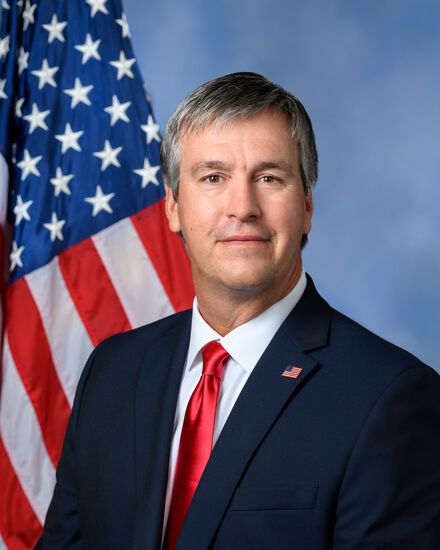
Barry Moore
U.S. Representative · AL-1
Voted Yea 1,875 · Nay 958 across 2,874 recorded votes.
Where their votes land
Contact their office
Office contact not on file here yet. The House directory lists it.
Not sure this is your member? Find who represents you.
Where their votes land
Each scale runs between the two parties. The left end is the side most Democrats took on a set of hand-picked roll-call votes, the right end the side most Republicans took, and Barry Moore's marker sits at the share of those votes they cast on the Republican side. Votes that most of both parties agreed on are left out, because they cannot show which side anyone was on.
Positions count only the votes this person cast, so two people can be placed on different numbers of votes — the count beside each value says how many. How the votes were chosen, and how each party's side is counted.
Where the money came from
Receipts into Barry Moore’s own campaign committee over the 2023–2024 election cycle, through December 31, 2024.
What these categories mean
- Small individual donors
- People whose giving stayed under $200 in total. The FEC does not require them to be named, so who they are is genuinely unknown — not merely unlisted.
- Large individual donors
- People whose giving passed $200, which is the point at which the campaign must report their name, employer and occupation.
- PACs
- Political action committees — corporate, trade, union and ideological. Money from an organisation rather than from a person.
- Self-funded
- The candidate's own money: what they gave the campaign outright plus what they lent it.
- Other and unclassified
- The remainder once every category above is accounted for: federal funds, offsets, interest, and anything this site could not classify. It is a residual, not a kind of donor.
This is money the campaign itself received. It is not everything spent to win the seat. It excludes leadership PACs, and it excludes independent expenditures and other outside spending — money spent to elect or defeat a candidate by groups they may not lawfully coordinate with, which in a contested race can exceed everything shown above. It is not personal income or net worth, which are a separate filing altogether. Figures are as filed with the Federal Election Commission and are only as current as the last report, covering through December 31, 2024; a cycle still running is a partial count. Check this filing on fec.gov.
Personal finances
Separately from the campaign money above, Barry Moore files a report about their own money: what they own, what they owe, what they earn outside Congress, and every stock trade they make. The law requires it, and every figure in it is a range rather than an amount — which is why the columns below are ranges too.
From Barry Moore’s own financial disclosure, filed under the Ethics in Government Act. Every figure is the band the filer ticked.
Government experience
| Chamber | State / District | Party | Years |
|---|---|---|---|
| House | AL-1 | Republican | 2025–2027 |
| House | AL-2 | Republican | 2023–2025 |
| House | AL-2 | Republican | 2021–2023 |
A district link opens that seat as the plan in force draws it. Seat numbers outlive the lines beneath them, so for an older term that is not the ground they held.
Their district
The ground Barry Moore represented, and what was measured on it while they held it. A seat listed twice is a seat whose boundaries were redrawn: the entries describe different areas, not the same area twice.
AL-1 119th Congress · 2025–2026
- Population735,4062020-2024
- Median age41.8 yrs2020-2024
- Median income$66,2912020-2024$68,035 in 2025 dollars
- Poverty rate14.2%2020-2024
- Child poverty rate19.9%2020-2024
- Unemployment rate4.4%2020-2024
AL-2 118th Congress · 2023–2025 · these lines
- Population717,0192019-2023
- Median age39.0 yrs2019-2023
- Median income$59,9542019-2023$63,346 in 2025 dollars
- Poverty rate16.8%2019-2023
- Child poverty rate24.6%2019-2023
- Unemployment rate4.7%2019-2023
AL-2 116th Congress · 2021–2023 · these lines
- Population689,6812017-2021
- Median age39.0 yrs2017-2021
- Median income$52,1942017-2021$62,012 in 2025 dollars
- Poverty rate17.3%2017-2021
- Child poverty rate25.9%2017-2021
- Unemployment rate5.4%2017-2021
Figures are the most recent published for each indicator in a period that ended while they held the seat — a figure published after they left describes their successor’s district. Allocated figures are built from the counties overlapping the district and carry the share of its residents the reporting sources covered. These are conditions in the district, not a record of the member. Nothing here is evidence that they caused any of it, or that a different representative would have produced different numbers.
Voting record
- H.R. 8884 — On PassageHouse · 119th Congress · Roll 643 · 2026-07-23 · PassedYea
- H.Con.Res. 89 — On Agreeing to the ResolutionHouse · 119th Congress · Roll 642 · 2026-07-23 · PassedNay
- H.Con.Res. 113 — On Agreeing to the ResolutionHouse · 119th Congress · Roll 641 · 2026-07-22 · PassedYea
- H.R. 7008 — On PassageHouse · 119th Congress · Roll 640 · 2026-07-22 · PassedYea
- H.R. 7008 — On Motion to RecommitHouse · 119th Congress · Roll 639 · 2026-07-22 · FailedNay
- H.R. 8800 — On PassageHouse · 119th Congress · Roll 638 · 2026-07-22 · PassedYea
- H.R. 8800 — On Motion to RecommitHouse · 119th Congress · Roll 637 · 2026-07-22 · FailedNay
- H.R. 8800 — On Agreeing to the AmendmentHouse · 119th Congress · Roll 636 · 2026-07-22 · FailedYea
- H.R. 8800 — On Agreeing to the AmendmentHouse · 119th Congress · Roll 635 · 2026-07-22 · Agreed toYea
- H.R. 8800 — On Agreeing to the AmendmentHouse · 119th Congress · Roll 634 · 2026-07-22 · FailedYea
- H.R. 8800 — On Agreeing to the AmendmentHouse · 119th Congress · Roll 633 · 2026-07-22 · Agreed toYea
- H.R. 9770 — On PassageHouse · 119th Congress · Roll 632 · 2026-07-21 · PassedYea
- H.R. 6955 — On PassageHouse · 119th Congress · Roll 631 · 2026-07-21 · PassedYea
- H.R. 6955 — On Motion to RecommitHouse · 119th Congress · Roll 630 · 2026-07-21 · FailedNay
- H.R. 8800 — On Agreeing to the AmendmentHouse · 119th Congress · Roll 629 · 2026-07-21 · FailedYea
- H.R. 8800 — On Agreeing to the AmendmentHouse · 119th Congress · Roll 628 · 2026-07-21 · Agreed toYea
- H.R. 8800 — On Agreeing to the AmendmentHouse · 119th Congress · Roll 627 · 2026-07-21 · Agreed toYea
- H.R. 8800 — On Agreeing to the AmendmentHouse · 119th Congress · Roll 626 · 2026-07-21 · FailedYea
- H.R. 8800 — On Agreeing to the AmendmentHouse · 119th Congress · Roll 625 · 2026-07-21 · Agreed toNot voting
- H.R. 8800 — On Agreeing to the AmendmentHouse · 119th Congress · Roll 624 · 2026-07-21 · FailedYea
- H.R. 8800 — On Agreeing to the AmendmentHouse · 119th Congress · Roll 623 · 2026-07-21 · FailedYea
- H.R. 8800 — On Agreeing to the AmendmentHouse · 119th Congress · Roll 622 · 2026-07-21 · FailedYea
- H.R. 8800 — On Agreeing to the AmendmentHouse · 119th Congress · Roll 621 · 2026-07-21 · FailedYea
- H.R. 8800 — On Agreeing to the AmendmentHouse · 119th Congress · Roll 620 · 2026-07-21 · Agreed toYea
- H.R. 8800 — On Agreeing to the AmendmentHouse · 119th Congress · Roll 619 · 2026-07-21 · FailedYea
- H.R. 8800 — On Agreeing to the AmendmentHouse · 119th Congress · Roll 618 · 2026-07-21 · Agreed toYea
- H.R. 8800 — On Agreeing to the AmendmentHouse · 119th Congress · Roll 617 · 2026-07-21 · FailedYea
- H.R. 8800 — On Agreeing to the AmendmentHouse · 119th Congress · Roll 616 · 2026-07-21 · FailedYea
- H.R. 8800 — On Agreeing to the AmendmentHouse · 119th Congress · Roll 615 · 2026-07-21 · FailedYea
- H.Res. 1438 — On Agreeing to the ResolutionHouse · 119th Congress · Roll 614 · 2026-07-21 · PassedYea
- H.Res. 1438 — On Ordering the Previous QuestionHouse · 119th Congress · Roll 613 · 2026-07-21 · PassedYea
- H.R. 1118 — On Motion to Suspend the Rules and Pass, as AmendedHouse · 119th Congress · Roll 612 · 2026-07-21 · PassedYea
- H.R. 8823 — On Motion to Suspend the Rules and Pass, as AmendedHouse · 119th Congress · Roll 611 · 2026-07-20 · PassedYea
- H.R. 4541 — On Motion to Suspend the Rules and Pass, as AmendedHouse · 119th Congress · Roll 610 · 2026-07-20 · PassedYea
- H.R. 9237 — On Motion to RecommitHouse · 119th Congress · Roll 609 · 2026-07-16 · FailedNay
- H.R. 5362 — On Motion to Suspend the Rules and PassHouse · 119th Congress · Roll 608 · 2026-07-16 · PassedYea
- H.R. 8595 — On PassageHouse · 119th Congress · Roll 607 · 2026-07-15 · PassedYea
- H.R. 8595 — On Motion to RecommitHouse · 119th Congress · Roll 606 · 2026-07-15 · FailedNay
- H.R. 8595 — On Agreeing to the AmendmentHouse · 119th Congress · Roll 605 · 2026-07-15 · FailedYea
- H.R. 8595 — On Agreeing to the AmendmentHouse · 119th Congress · Roll 604 · 2026-07-15 · FailedNay